In brief
- ADHD coaching is practical, forward-looking support with how you work day to day. For managers and leaders, that can often mean prioritising, protecting time for strategic work, following through, delegating and having the conversations that keep getting put off.
- It isn’t diagnosis, therapy or medical treatment. Therapy works on your mental health and emotional wellbeing, and medication is prescribed and reviewed by clinicians. Coaching can sit alongside both.
- Unlike mentoring, a coach doesn’t hand you their way of leading. You set the agenda, and the coach helps you think, try things out and make the changes stick.
- You don’t need a diagnosis. Coaching suits leaders who want practical change at work and are ready to experiment between sessions.
- ADHD leadership coaching applies all of this to leading yourself and leading others.
When managers and leaders first get in touch about ADHD coaching, one of the most common questions is some version of “So is it a bit like therapy?” It’s a really good question, and the short answer is: sometimes it can feel similar, but it’s doing a different job.
Getting this clear matters, especially when you’re leading people. You might be waiting months (or years) for an assessment, juggling medication reviews, or wondering whether what you need is a therapist, a coach, a mentor or simply a quieter diary. And you’re probably doing all of that while running a team, carrying a full inbox and being the person everyone else comes to with their problems. So here’s a plain-English guide to what ADHD coaching is, what it isn’t, how it compares with therapy, medication and mentoring, and who it’s likely to help.
What is ADHD coaching?
ADHD coaching is a collaborative, practical partnership that helps you make changes in how you work with ADHD. It’s focused on the present and the future: what’s working well, where your strengths are, what’s getting in the way, what you want to be different, and what you’re going to try next.
A lot of that work is about executive function, the planning, prioritising, starting, switching, remembering and following through that can feel so much harder than it should. Leadership roles lean on these skills heavily. You’re expected to hold the big picture and the detail, switch between back-to-back meetings, make decisions with incomplete information, and still find time for the strategic work that never feels urgent until it’s overdue. Coaching helps you understand how ADHD shows up for you in that context, then build structures, habits and conversations that work with your brain rather than against it.
A good coach won’t tell you what to do. Coaching is a non-directive approach, so you set the agenda and the coach helps you think it through, notice your patterns and decide on your next step. That said, with ADHD coaching there’s often a bit more structure and practical input than in other kinds of coaching, drawing on the research and evidence on ADHD and behaviour change, because for many leaders with ADHD, knowing what to do isn’t the problem. You could probably write the textbook on good leadership. Doing it consistently on a busy Tuesday afternoon, with 47 other things competing for your attention, is the hard part.
What ADHD coaching isn’t
I want to be really clear about this, because it’s important and it’s where the confusion usually starts.
I’m not a clinician, I do not diagnose, and I wouldn’t even call myself an ADHD or neurodivergence expert. I’m a coach. My background is in psychology, behaviour change and NHS commissioning, where neurodevelopmental services were one of my specialist areas, and I’ve done a lot of learning about ADHD. But that doesn’t make me qualified to assess you, treat you or advise on your medication, and any coach who suggests otherwise is stepping outside their lane.
So ADHD coaching isn’t:
- An assessment or diagnosis. A coach can’t tell you whether you have ADHD. That’s a clinical assessment, carried out by a qualified specialist.
- Therapy. Coaching doesn’t treat mental health conditions such as depression, anxiety disorders or trauma.
- Medical advice. A coach shouldn’t advise you to start, stop or change medication. That’s a conversation for your prescriber.
- A performance management tool. If your organisation pays for coaching, it’s there to support you, not to monitor you. What you talk about stays between you and your coach.
- A quick fix. Coaching is about building skills and habits over time. It takes some effort between sessions, and nobody can promise it will “fix” anything in a set number of sessions.
How is ADHD coaching different from therapy?
There’s some overlap. Both involve a confidential relationship, a lot of listening, and someone helping you see things from a different angle. And coaching conversations can absolutely touch on feelings. It’s hard to talk about years of being the leader who’s brilliant in a crisis but always behind on the paperwork without some emotion coming up. But the focus and the purpose are different.
Therapy (such as counselling, psychotherapy or cognitive behavioural therapy) is a form of health care. It’s there to help with your mental health and emotional wellbeing, and it may explore the past to understand how it’s shaping the present. For adults with ADHD, the NICE guideline on ADHD recommends that non-medication treatment should include, as a minimum, a structured supportive psychological intervention focused on ADHD, which may include CBT. Research summarised by the National Institute for Health and Care Research suggests CBT can help adults with ADHD symptoms, including alongside medication.
Coaching isn’t health care. It assumes you’re broadly well enough to be focusing on change, and it’s oriented towards action: what you want to achieve in your role, what’s getting in the way, and what you’ll try this week. It spends much less time on why things are the way they are, and much more on what happens next.
A simple way to think about it: if what’s mostly getting in the way is your mental health (low mood, anxiety that’s taking over, burnout, trauma, or feeling unsafe), start with your GP or a therapist. If you’re broadly OK but stuck on the practical side of leading, such as your diary, your priorities, your follow-through or your team, coaching may be a good fit. And many people benefit from both at the same time.
What about medication?
For adults, NICE recommends that changes to your environment are put in place and reviewed first, and that medication is offered if ADHD symptoms are still causing significant problems. Medication is prescribed and monitored by specialists, sometimes together with your GP. As one NHS trust explains, medication doesn’t cure ADHD, but it can help with focus and impulsiveness and make it easier to learn and practise new skills.
That last part is where coaching often comes in. Medication can make it easier to focus, but it doesn’t decide what you should focus on. It won’t redesign your week, delegate the task you keep holding onto, or have the difficult conversation with a team member for you. Coaching works on those skills and systems. Some leaders who come to coaching take medication, some don’t, some are waiting to start and some have decided it isn’t for them. All of that is fine. It’s your decision, made with your clinician, and it isn’t something a coach should weigh in on.
And mentoring?
Leaders are often offered mentoring, so it’s worth being clear on the difference. Mentoring and coaching use a lot of the same skills, such as listening and asking good questions, and the words often get used interchangeably. The main difference is where the answers come from.
The CIPD describes workplace mentoring as a more experienced colleague sharing their knowledge to help someone develop, usually over a longer period. A mentor’s value is their experience: “here’s how I handled it when I was in your role”. A coach doesn’t need to have done your job. Their value is helping you find what works for you.
Both can be useful, and a good mentor can be brilliant for understanding your organisation, its politics and the unwritten rules. The risk with mentoring on its own is that a mentor’s tried-and-tested way of managing their diary, their inbox or their team was built for their brain. If it doesn’t suit yours, you can end up feeling like you’ve failed at something that was never designed for you in the first place.
Coaching, therapy, medication and mentoring at a glance
| Main focus | Who provides it | The question it helps a leader with | |
|---|---|---|---|
| ADHD coaching | Practical change in how you work and lead, now and next | A coach, ideally with recognised training, supervision and ADHD experience (coaching isn’t regulated in the UK) | “What will I do differently this week, and how will I make it stick under pressure?” |
| Therapy | Mental health and emotional wellbeing, sometimes including the past | A therapist, counsellor or psychologist | “Why do I feel like this, and how can I feel better?” |
| Medication | Reducing core ADHD symptoms such as inattention and impulsiveness | A specialist prescriber, sometimes shared with your GP | “Can my symptoms be eased enough to make the working day more manageable?” |
| Mentoring | Learning from someone else’s experience, often over the longer term | A more experienced leader or peer | “How did you handle this when you were in my position?” |
They aren’t in competition. Plenty of leaders use two or three of these at once, and they often work better together.
Who is ADHD coaching for?
You don’t need a diagnosis to have coaching. Lots of leaders are self-identified, on a waiting list, or not sure they want an assessment at all, and that’s absolutely fine. Acas guidance says employers should offer support whether or not someone has a diagnosis, and an independent expert panel report published by the government in October 2026 recommends support based on need rather than diagnosis.
ADHD coaching tends to suit you if:
- ✓You manage people, lead a service or run your own business, and the demands of the role are outpacing the systems that used to get you by
- ✓You know what good leadership looks like, but find it hard to do consistently when you’re under pressure
- ✓Strategic work keeps getting squeezed out by firefighting, meetings and everyone else’s questions
- ✓You’re willing to experiment between sessions and talk openly about what didn’t work
- ✓You’re broadly well enough to be focusing on change right now
It’s probably not the right starting point if you’re struggling with your mental health, heading towards burnout, feeling in crisis, or need help with an assessment or medication. In that case, please speak to your GP first, or contact NHS 111 if you need help urgently. Coaching can still be there for you later, and a good coach will tell you if they think other support would serve you better. That’s part of our professional code: the EMCC Global Code of Ethics, which we both work to, asks coaches to work within their competence and refer clients on when another kind of help is needed.
What does an ADHD coaching session look like?
Every coach works a bit differently, so it’s worth asking. Here’s how it works with us, and why.
Our ADHD leadership coaching runs over 12 weeks, in three four-week Focus Cycles. Rather than one long session a month, there’s a mix of longer and shorter sessions. That’s because the aim isn’t just a good conversation. It’s to give you the structure and support to build new habits that last. Over the 12 weeks, it looks like this:
- Deeper coaching sessions (60 minutes). One at the start of each Focus Cycle, and one to close the programme. This is where we step back, look at the bigger picture and agree what you’re working on.
- Weekly review and action sessions (30 minutes). Shorter check-ins in the weeks in between, to celebrate what went well, troubleshoot what didn’t and decide what to try next.
- Body doubling. Protected time to get on with the work, alongside someone else.
- Light-touch text check-ins. Small nudges between sessions, plus a shared working document so your priorities stay visible.
Here’s what each part looks like in practice, starting before you’ve signed up to anything.
Your first session
Everything starts with a complimentary 60-minute session. It’s a real coaching session rather than a sales call, so you bring something that’s on your mind at work and we work on it together. You’ll get a feel for how coaching works, and we’ll both get a sense of whether it’s the right fit. There’s no obligation to continue.
Deeper coaching sessions: setting the direction
If you decide to go ahead, we start by agreeing what you want to be different in your role. That means one meaningful outcome, a couple of behaviours that would help you get there, and the situations where those behaviours need to happen. We also agree how we’ll know if it’s working, because “be more organised” is hard to measure, but “start the board report on the day I planned to” isn’t.
Weekly review and action sessions
Here’s what a 30-minute weekly review might look like. You arrive and we look back at the week. You planned to block out Tuesday morning for a strategy paper. You did it once, and the second week it got swallowed by a “quick” meeting that ran for two hours.
First, we celebrate. You protected that time once, and that counts. It’s all too easy to focus only on what isn’t working, so we make a point of noticing wins, big or small. Then we get curious, without judgement. What made the first week work? What got in the way the second time? Then you decide what to try next. Maybe it’s working somewhere your team can’t find you, letting them know who to go to instead, or using a body doubling session to get started. You leave with one or two clear actions, and we check in on how they went next week.
That rhythm of pausing, prioritising, trying, noticing, celebrating and adapting is the heart of it. It sounds simple, but for many leaders with ADHD the gap between knowing and doing is exactly where things fall apart, and regular, shorter check-ins help close that gap.
Support between sessions
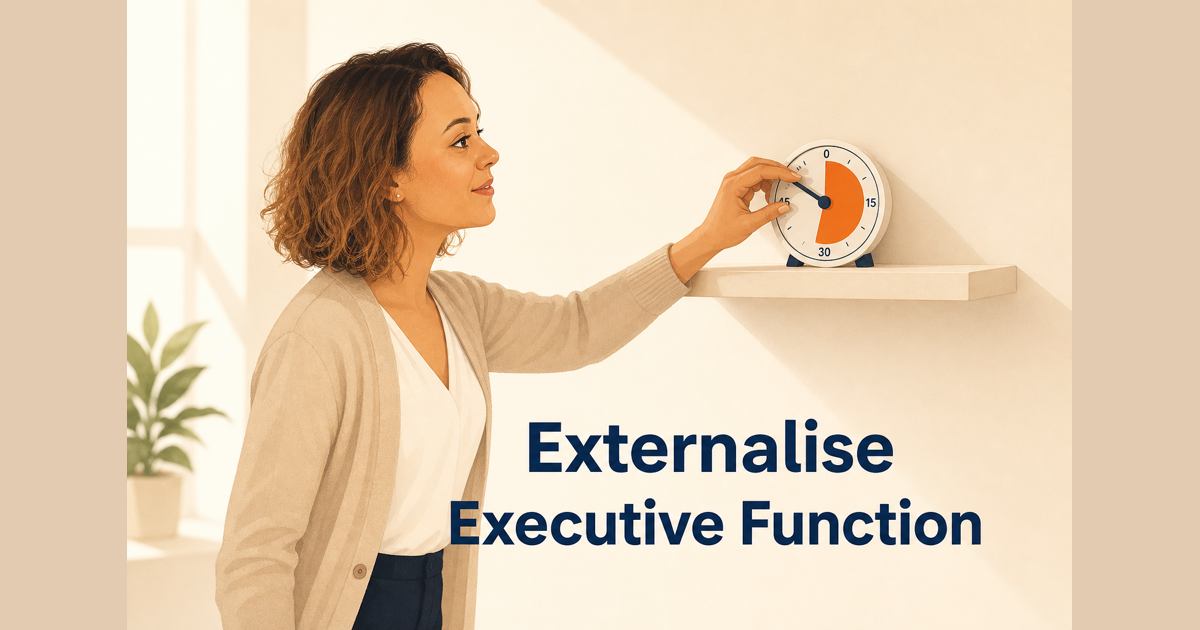
Alongside the coaching, we offer body doubling (protected time working alongside someone else, which can make it much easier to get started on the report, the appraisal paperwork or the email you’ve been avoiding), light-touch text check-ins and a shared working document, so your priorities and actions stay visible rather than disappearing into a notebook you can’t find. All of this is there for one reason: to give you enough structure and support that new habits start to stick, and keep going after the coaching ends. You can read more about why we externalise executive function rather than relying on willpower.
Why coaching for leaders with ADHD is a bit different
General ADHD coaching can cover all of life: routines at home, relationships, study, money and work. ADHD leadership coaching is more focused. It’s for managers and leaders with diagnosed or self-identified ADHD or executive-function differences, and it concentrates on the challenges that show up at work.
That might be about leading yourself, such as prioritising when everything feels urgent, protecting time for strategic thinking, following through and finding a more sustainable way of working. Or it might be about leading others: delegating, building ownership in your team so fewer problems bounce back to you, setting boundaries, and having the conversations you’ve been putting off.
These are the same issues that come up in any leadership coaching. The difference is that we also look at how ADHD and executive function affect putting good ideas into practice under pressure, and we add more structure and support to help the changes stick. Leadership also brings its own twist. The higher you go, the less structure you’re given, the more your time belongs to other people, and the harder it can feel to admit you’re struggling. If you’ve ever thought “I know exactly what a good leader would do here, I just can’t seem to do it consistently”, that’s what this work is for.
Our ADHD leadership coaching programme runs for 12 weeks, built around three four-week Focus Cycles, and you can try a single Focus Cycle first if you’d like to see whether it’s right for you. If you’re wondering about price, our guide to how much ADHD coaching costs in the UK covers typical prices, funding options including Access to Work, and exactly what we charge.
Other questions people ask
Can I have coaching and therapy at the same time?
Yes, and many people do. They focus on different things, so they often complement each other well. If you’re seeing a therapist, it can help to let both of us know, so we’re not pulling you in different directions.
Do I have to tell my organisation I have ADHD to get coaching?
No. You can arrange coaching privately, and whether you talk to your organisation about ADHD is entirely your choice. If you’d like your organisation to fund it, or to be involved, that’s possible too. Some leaders find it helpful to use coaching to think through what, if anything, they want to share and with whom.
I manage someone with ADHD. Can coaching help them?
It can, as long as it’s their choice. Coaching works best when someone wants it, rather than when it’s arranged for them. It also helps to be clear from the start that coaching is support, not a performance process, and to agree what (if anything) will be shared with you. Acas has useful guidance on adjustments you can talk about together, and coaching can sit alongside those.
What if I’m autistic or AuDHD?
Coaching can still be a really good fit. Everyone’s experience is different, so we don’t make assumptions. We start with how things show up for you. For AuDHD people, for example, there can be a push and pull between the ADHD side wanting novelty and the autistic side needing structure and routine. You can read more on our ADHD leadership coaching page.
Does ADHD coaching work?
The research is still developing, but it’s encouraging. A 2026 study of 12-session ADHD coaching found improvements in ADHD symptoms, executive functioning and day-to-day functioning, although it didn’t have a comparison group, so it can’t prove the coaching caused the change. In practice, coaching tends to work best when you have a clear outcome in mind and a coach who checks progress with you regularly.
Is ADHD coaching available on the NHS?
Not routinely. Some NHS services and employers offer it, but it’s limited and varies a lot depending on where you live and work. Many people fund coaching through their employer, through the government’s Access to Work scheme, or themselves. Our cost guide goes through the options.
How do I choose a good ADHD coach?
Coaching isn’t regulated in the UK, so it’s worth asking a few questions before you book. Ask about their training, professional body membership, supervision and ADHD experience, and how you’ll know if it’s working. Our cost guide has a full list of questions to ask any coach. And notice how the first session feels: you should leave feeling understood and with something useful.
Does my coach need to have ADHD?
Not necessarily. Lived experience can bring real understanding, and Neil, my business partner and fellow coach, has lived experience of ADHD. What matters most is that your coach has good coaching training, understands how ADHD can affect work and leadership, has regular supervision, and that you feel comfortable working with them. You can choose which of us you’d like to work with.
Is coaching online or in person?
All our coaching is online by video call, including body doubling, so it fits around your diary without any travel.
What if something difficult comes up in a coaching session?
It sometimes does, and that’s OK. We’ll make space for it. If it looks like you’d be better supported by a therapist or your GP, we’ll talk about that openly with you, and coaching can pause or carry on alongside that support, whichever is most helpful.
If my employer pays, will they know what we talk about?
Not with us. We never share the private content of coaching conversations. If your organisation is involved, we agree together at the start what progress information is shared, and only that is shared.
Start with a conversation
If you’re still not sure whether coaching, therapy or something else is the right next step for you, that’s a perfectly good thing to bring to a first session. Your complimentary 60-minute session is a real coaching conversation, not a sales call, and there’s no obligation to continue afterwards. If it turns out something else would suit you better, we’ll tell you.
You can also read more about how our ADHD leadership coaching works, including the Focus Cycles and prices.